


Best Quality C_THR92_2505 Exam Questions SAP Test To Gain Brilliante Result!
Preparations of C_THR92_2505 Exam 2026 SAP Certified Associate Unlimited 80 Questions
SAP C_THR92_2505 Exam Syllabus Topics:
| Topic | Details |
|---|---|
| Topic 1 |
|
| Topic 2 |
|
| Topic 3 |
|
| Topic 4 |
|
NEW QUESTION # 44
A report consumer claims that a canvas report shared with them is NO longer available in Report Center.
Upon your investigation, you find the report has been deleted. You need to reproduce the report as quickly as possible. What action do you take?
- A. Contact SAP SuccessFactors support to request the report be restored.
- B. Create a new report and add orphaned pages. Share the report.
- C. Use the Recycle Bin to restore the Report.
- D. Use the Restore Deleted Report tool to restore the report.
Answer: D
Explanation:
* Understanding Report Restoration
* SAP SuccessFactors provides the Restore Deleted Report tool to recover reports that have been unintentionally deleted from the Report Center. This is the fastest method to restore a deleted report.
* Why Other Options are Incorrect
* B (Create a new report and add orphaned pages): This is time-consuming and only useful if the report cannot be restored.
* C (Contact SAP Support): This is unnecessary as the Restore Deleted Report tool is available.
* D (Recycle Bin): The Recycle Bin does not exist for reports in SAP SuccessFactors.
References
* SAP SuccessFactors Report Center User Guide
NEW QUESTION # 45
In the Advanced Reporting tool, you want to create a query where the results meet the following criteria: Only show one row per employee, Only show the pay components Base Salary and Bonus, Show these pay components as individual columns. You have joined the Global Job Information table with the Compensation table.What else must you do? Note: There are 2 correct answers to this question.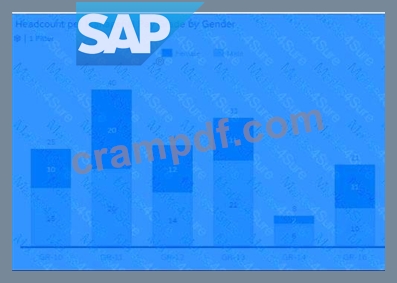
- A. Duplicate the Compensation table.
- B. Change the table join to the Compensation table to an inner join.
- C. Configure a table restriction of the Compensation table.
- D. Configure a table restriction of the Global Job Information table.
Answer: A,C
Explanation:
To meet the specified query requirements in Advanced Reporting:
* Duplicate the Compensation Table (B):
* You must duplicate the table to represent Base Salary and Bonus as separate columns. Each instance of the table focuses on one pay component.
* Configure a Table Restriction of the Compensation Table (C):
* Apply restrictions to filter the data in each duplicated table to only include the specific pay component (e.g., Base Salary in one table and Bonus in the other).
NEW QUESTION # 46
You are creating a Story report on employment and compensation information. You have created two queries to support the story report. The table and the left chart are using an employment query as its data source. The right chart uses a compensation query as its data source. Both queries include the field for the employee Job Title. When you add an input control to the page, it only filters the table and the left chart. What action must you take to configure the input control to effect both charts and the table?
- A. Enable Cascading Effects.
- B. Convert it to a Story Filter.
- C. Update Linked Analysis.
- D. Set up Linked Dimensions.
Answer: D
Explanation:
* Problem Description
* The input control must filter multiple queries (employment and compensation) by the Job Title field. This requires linking dimensions across the queries.
* Solution: Linked Dimensions
* Configuring Linked Dimensions connects the shared field (Job Title) between the queries. This ensures the input control affects all visuals based on the linked field.
* Why Other Options are Incorrect
* A (Story Filter): Applies filters globally but does not link dimensions between queries.
* B (Update Linked Analysis): Handles interactivity within a single query but not across multiple queries.
* C (Enable Cascading Effects): This is unrelated to linking dimensions.
References
* SAP SuccessFactors Linked Dimensions Guide
NEW QUESTION # 47
You need to create a chart of type Indicator: Numeric Point that displays the following output:
count of employees with the gender male divided by the count of employee with the gender female.
The chart can then be filtered for different departments. What calculation is required to create the metric?
- A. In Query Builder, use a calculated column.
- B. In Chart Builder, use a calculation of type: Restricted Measure.
- C. In Chart Builder, use a calculation of type: Aggregation.
- D. In Chart Builder, use a calculation of type: Calculated Measure.
Answer: D
Explanation:
* Understanding the Chart Type
* Indicator: Numeric Point charts display a single numeric value based on a calculated metric.
* The desired output requires dividing the count of male employees by the count of female employees.
* Solution
* A Calculated Measure in Chart Builder is the appropriate method to perform this calculation within the context of the chart.
* Why Other Options are Incorrect
* A (Aggregation): Aggregation alone cannot handle the required calculation.
* B (Calculated Column): Calculated columns are created at the query level and are not specific to the chart.
* D (Restricted Measure): Restricted measures limit data based on conditions but do not perform calculations across dimensions.
References
* SAP SuccessFactors Chart Builder Guide
NEW QUESTION # 48
What setting in Provisioning enables Live data source?
- A. Platform Client
- B. LMS Client API
- C. EC Client
- D. Workforce Analytics Client
Answer: A
Explanation:
* Enabling Live Data Source
* The Platform Client setting in Provisioning is required to enable the Live data source, which allows real-time data retrieval for reports.
* Why Other Options are Incorrect
* B (EC Client): Pertains to Employee Central but does not enable live data.
* C (Workforce Analytics Client): Relates to Workforce Analytics, not live data.
* D (LMS Client API): Specific to Learning Management System data integration.
References
* SAP SuccessFactors Provisioning Guide
NEW QUESTION # 49
In Query Designer, you are trying to create a conditional expression to relabel a field. You create the following expression: IF([User#Basic User Information#Gender] = "M" , "Male" : "Female") You received an error message saying the formula could NOT be computed. Which symbol in your expression is causing the error?
- A. ,
- B. :
- C. #
- D. "
Answer: B
Explanation:
* Understanding the Query Designer Expression SyntaxIn SAP SuccessFactors People Analytics Query Designer, conditional expressions are used to transform or relabel fields based on logical conditions.
These expressions rely on specific syntax that must be adhered to strictly. The issue in this scenario arises from the use of an incorrect separator in the conditional statement.
* Analyzing the Given ExpressionThe expression provided:
IF([User#Basic User Information#Gender] = "M" , "Male" : "Female")
contains a colon (:) as the separator between "Male" and "Female". However, the correct syntax requires the use of a comma (,) instead of the colon.
* Correct Syntax Format for Conditional ExpressionsThe correct format for conditional expressions in SAP SuccessFactors People Analytics IF(Condition, Value_if_True, Value_if_False) Applying this to the provided example, the correct expression should be:
IF([User#Basic User Information#Gender] = "M", "Male", "Female")
* Root Cause of the ErrorThe colon (:) is not recognized as a valid syntax separator in the Query Designer's conditional expression format. As a result, the formula cannot be computed, and an error is generated.
* Resolving the IssueReplace the colon (:) with a comma (,), ensuring the conditional expression adheres to the correct syntax. The updated expression would look like this:
IF([User#Basic User Information#Gender] = "M", "Male", "Female")
* ValidationOnce corrected, the expression can be tested in Query Designer to confirm it computes without errors and provides the expected output.
References and Documentation
* SAP SuccessFactors People Analytics Reporting Guide: SAP Help Portal
* Conditional Expressions in People Analytics: Official documentation and training materials available on openSAP
* Query Designer Syntax Guidelines: Found in the SAP SuccessFactors People Analytics Query Designer User Guide.
Make sure to consult the above documentation for additional examples and syntax rules.
NEW QUESTION # 50
In a live data query, what are user-prompted filter types? Note: There are 2 correct answers to this question.
- A. Dynamic
- B. Filter Groups
- C. People Scope
- D. Runtime
Answer: C,D
Explanation:
* Runtime Filters (A):
* These are filters that the user is prompted to set when executing a report. The user can define filter criteria dynamically at runtime.
* People Scope (D):
* This filter type allows reports to be filtered based on groups or populations defined in the user's permissions, such as specific departments or locations.
NEW QUESTION # 51
Which are valid destinations of a scheduled Report Distributor bundle? Note; There are 3 correct answers to this question.
- A. Home Page
- B. Run Offline
- C. Notification
- D. E-Mail
- E. FTP
Answer: B,D,E
Explanation:
In SAP SuccessFactors Report Distributor, scheduled bundles are used to deliver reports to predefined destinations. The valid destinations include:
* Run Offline (C):
* This option allows reports to be generated and stored in the "My Jobs" section of the user who scheduled the report.
* It is particularly useful for large reports that take time to generate.
* FTP (D):
* Reports can be sent directly to an external server using FTP (File Transfer Protocol).
* This requires configuring FTP server details in the system before scheduling the bundle.
* E-Mail (E):
* Reports can be sent to recipients via email as attachments.
* You need to specify valid email addresses during report scheduling.
NEW QUESTION # 52
You are using a Multi-Dataset table report without Business Intelligence Reporting Tools (BIRT). What are characteristics of the report output? Note: There are 2 correct answers to this question.
- A. Report results are shown on separate tabs in the output.
- B. Data is joined in the query.
- C. Report results are shown on a single tab in the output.
- D. Data is NOT joined in the query.
Answer: A,D
Explanation:
When using a Multi-Dataset Table Report without Business Intelligence Reporting Tools (BIRT), the following characteristics apply:
* Report results are shown on separate tabs in the output (A):
* Each dataset's output is displayed on its respective tab. This is because the data is not integrated or merged in the query.
* Data is NOT joined in the query (D):
* Multi-dataset reports without BIRT do not perform data joins. Each dataset is treated independently.
NEW QUESTION # 53
You have created a custom MDF object to track company car information. You need to be able to create story reports on the data of the custom MDF object. What must you do to enable a custom MDF object to be listed in the Available Data section of Query Designer?
- A. Update the Report Object Configuration Entity record for the object and set it as a root report object.
- B. Create a custom schema join using the Report Schema Join Manager tool.
- C. Update the Report Object Configuration Entity record for the object and associate the object with a schema.
- D. Create a Report Schema Configuration Entity Record.
Answer: C
Explanation:
* Scenario Analysis
* Custom MDF (Metadata Framework) objects, such as company car information, must be configured properly to appear in the Available Data section of the Query Designer.
* Solution
* Updating the Report Object Configuration Entity (ROCE) record to associate the custom MDF object with a schema ensures it is recognized in the reporting layer.
* Why Other Options are Incorrect
* A: Creating a custom schema join is not necessary to make the object available.
* C: Report Schema Configuration Entity is not applicable in this context.
* D: Setting it as a root report object is not required for inclusion in Query Designer.
References
* SAP SuccessFactors Reporting Configuration Guide
NEW QUESTION # 54
When you use a column of type text as a measure in a pivot query, which of the following pivot functions are available? Note: There are 2 correct answers to this question.
- A. Distinct Count
- B. Concatenate
- C. Sum
- D. Max
Answer: A,B
Explanation:
* Concatenate (B):
* Text columns can be concatenated, combining multiple values into a single string.
* Distinct Count (D):
* This function counts the number of unique entries in the text column.
NEW QUESTION # 55
You are creating a Story report on Job Classifications. You have configured the chart, table, and input control on the canvas, as displayed in the screenshot. How do you set the input control?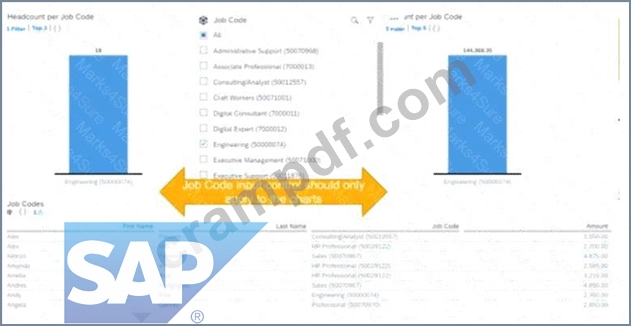
- A. Enable Cascading Effects.
- B. Create the corresponding filter on each chart.
- C. Convert it to a Story Filter.
- D. Configure it for Linked Analysis.
Answer: D
Explanation:
* Linked Analysis
* Configuring input controls for Linked Analysis allows interactions between components (charts, tables) on the same canvas, enabling filters to apply only to selected visuals.
* Why This is Correct
* In the scenario, the input control must affect only the charts and not the table. Linked Analysis ensures this targeted filtering behavior.
* Why Other Options are Incorrect
* B (Create Filters): Manually adding filters is redundant when Linked Analysis can automate the behavior.
* C (Enable Cascading Effects): Cascading effects affect hierarchical filters but are unrelated to input control behavior here.
* D (Convert to Story Filter): A Story Filter would apply globally, affecting all elements, which is not desired.
References
* SAP SuccessFactors Linked Analysis Feature Guide
NEW QUESTION # 56
When constructing an expression for a calculated column in Query Designer, which syntax should you use to enter a date?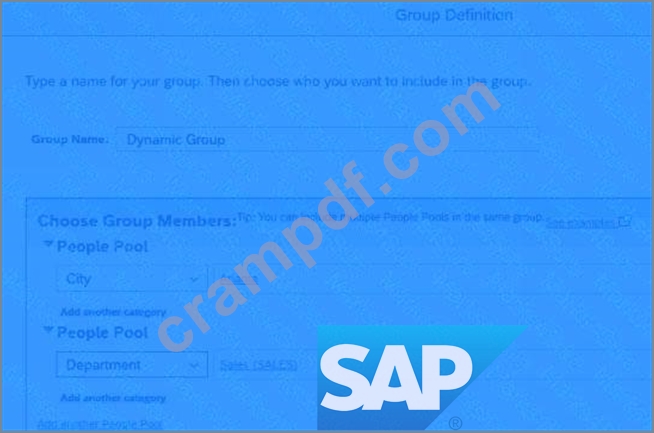
- A. #MMM-DD-YYYY#
- B. #YYYY-MM-DD#
- C. #DD-MM-YYYY#
- D. #MM-DD-YYYY#
Answer: B
NEW QUESTION # 57
A user reports they are unable to successfully create a new Story report in Report Center. The page is stuck in a blank loading screen. How do you validate the user exists and has the proper configuration in the SAP Analytics Cloud Solution?
- A. In the SAC instance, use the Users tool to verify the account exists and is assigned the correct u role.
- B. In the SuccessFactors HXM suite, use the Employee Export tool to verify the employee has a u PERSON_GUID assigned.
- C. In the WFA administrative area, use the User Maintenance tool to verify the account exists and is assigned the correct role.
- D. In the SuccessFactors HXM suite, use the check tool to run the "Availability of user record for v u People Analytics" check.
Answer: D
Explanation:
* Validation Using the Check Tool:
* The Check Tool in SuccessFactors HXM Suite includes a predefined check for validating whether a user exists and is correctly configured for People Analytics (e.g., Story Reporting in SAP Analytics Cloud).
* Running the "Availability of user record for People Analytics" check ensures the user record is properly synced.
* Steps:
* Go to Admin Center # Check Tool.
* Search for and run the "Availability of user record for People Analytics" check.
NEW QUESTION # 58
In Detailed Reporting, what functionality can be used in a calculated column? Note; There are 2 correct answers to this question.
- A. Concatenation
- B. Average
- C. Data type conversion
- D. If/Then/Else statement
Answer: A,B
Explanation:
* Concatenation (A):
* Calculated columns support concatenating text fields to create combined values (e.g., "First Name + Last Name").
* Average (C):
* Aggregating numerical data (e.g., computing the average of a numeric field) is supported in calculated columns.
NEW QUESTION # 59
Which tool can you use to upload a report from the test instance to the production instance? Note: There are 2 correct answers to this question.
- A. Report Transfer
- B. SFTP Configuration
- C. Report Distributor
- D. Report Center
Answer: A,D
Explanation:
* Report Transfer (A):
* The Report Transfer tool is specifically designed to move reports from one instance (test) to another (production).
* Report Center (D):
* Reports can also be exported and imported manually using the Report Center if the report type supports it.
NEW QUESTION # 60
Which of the following steps do you take to import an SAP SuccessFactors-provided story report template?
Note: There are 3 correct answers to this question.
- A. Select Import Data in Import and Export Data tool.
- B. Select Import in Report Center.
- C. Select the template and choose Import.
- D. Choose the SAP SuccessStore.
- E. Choose the Content Store tab.
Answer: B,C,E
Explanation:
To import an SAP SuccessFactors-provided story report template:
* Select the Template and Choose Import (A):
* Navigate to the list of available templates in the Report Center.
* Select the specific template and click the "Import" option.
* Choose the Content Store Tab (D):
* Access the Content Store to locate story report templates provided by SAP.
* This is where prebuilt reports and templates are made available.
* Select Import in Report Center (E):
* The actual import process is completed through the Report Center by choosing the import option.
NEW QUESTION # 61
An executive reviews a canvas report on employee compensation. The executive discovers that NOT all employees are included in the report. You need to adjust the report so that all employees are included by default, but included employees can be adjusted at runtime. How do you accomplish this task? Note: There are 2 correct answers to this question.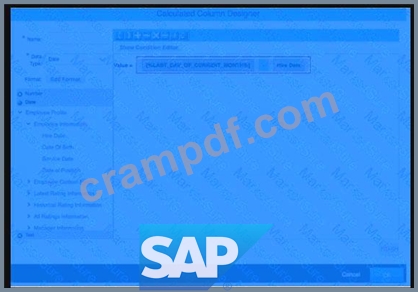
- A. Set the People Scope Team Manager to CEO and set Team Reporting Type to Team View.
- B. Set the People Scope Team Manager to Logged in User and set Team Reporting Type to other filters.
- C. Set a run-time filter on User Sys ID.
- D. Enable User Prompted People Scope.
Answer: B,D
Explanation:
To include all employees in a report by default and allow runtime adjustments:
* Enable User Prompted People Scope (A):
* This allows the report runner to adjust the scope of employees included at runtime.
* Set the People Scope Team Manager to Logged in User and Team Reporting Type to Other Filters (B):
* By configuring the People Scope, all employees are included by default based on the team hierarchy, but the user can apply additional runtime filters to adjust the scope.
NEW QUESTION # 62
A table report is shared with a user. That user CANNOT see the table report in the Report Center list. Which role-based permission has NOT been set correctly for this user?
- A. Create Report access to the domain
- B. Access to Insights
- C. Run Report access to the domain
- D. Ability to manage Tiles and Dashboards
Answer: C
Explanation:
When a user cannot see a table report in the Report Center list, the issue typically stems from insufficient role- based permissions (RBP) granted to the user for accessing reports in that domain. Specifically:
* Understand Role-Based Permissions (RBP):
* In SAP SuccessFactors, reports and analytics visibility is governed by RBP settings. These settings ensure that users only see the reports and data they are authorized to access.
* Permissions are categorized into domains such as "Employee Central," "Performance Management," etc.
* Key Permissions for Reports in the Report Center:To view or run reports in Report Center, users need:
* Run Report Access: This allows users to execute reports for domains they are permitted to access.
* Create Report Access: This enables users to create or modify reports.
* Manage Tiles and Dashboards Access: This is necessary for interacting with dashboards and tiles, not table reports specifically.
* Access to Insights: This refers to viewing analytic insights and does not directly impact table report visibility.
* Diagnosing the Issue:
* The given scenario describes a user being unable to view a shared table report.
* The most likely cause is the absence of Run Report access to the domain associated with the table report.
* Without this permission, the system restricts the user from running or even viewing the report, even if it has been shared with them.
* Steps to Resolve:
* Navigate to Admin Center # Manage Permission Roles.
* Select the permission role assigned to the user in question.
* Click Permissions # Reports Permissions.
* Verify that the Run Report Permission is granted for the specific domain associated with the shared report.
* If not, enable this permission and save the changes.
* Test Access:
* After updating the permissions, the user should be able to view the table report in the Report Center.
* SAP SuccessFactors Help Portal: Role-Based Permissions
* SAP SuccessFactors People Analytics Reporting Guide (Latest Release): Check for details on report permissions and their implications.
* SAP KBA 2461114: Troubleshooting Report Center permissions.
* Learning Path: SAP Open Learning on SuccessFactors RBP and Analytics (openSAP).
Step-by-Step Analysis:References and Documentation:This explanation ensures that the resolution is precise, supported by standard SAP practices, and verifiable through official SAP documentation.
NEW QUESTION # 63
......
Focus on C_THR92_2505 All-in-One Exam Guide For Quick Preparation: https://actualtests.crampdf.com/C_THR92_2505-exam-prep-dumps.html