


Updated Jun-2026 300-630 Exam Practice Test Questions
Verified 300-630 dumps Q&As 100% Pass in First Attempt Guaranteed Updated Dump
NEW QUESTION # 63
A network engineer configured an active-active firewall cluster that is stretched across separate pods in the Cisco ACI fabric. Which two implementation setups for anycast services are available? (Choose two.)
- A. Modify the Cisco ACI contract scope
- B. Modify the MAC address on the second firewall
- C. Deselect No Default SVI Gateway under EPG Subnet
- D. Deploy a Layer 4 to Layer 7 service graph with PBR
- E. Configure the firewalls behind an EPG subnet
Answer: B,E
NEW QUESTION # 64
A company must connect three Cisco ACI data centers by using Cisco ACI Multi-Site. An engineer must configure the Inter-Site Network (ISN) between the existing sites.
Which two configuration steps must be taken to implement the ISN? (Choose two.)
- A. Configure OSPF on subinterfaces on routers that are directly connected with spine nodes.
- B. Configure OSPF on all ISN routers.
- C. Configure encapsulation VLAN-4 between the routers and spine nodes.
- D. Configure BIDIR-PIM on all ISN routers.
- E. Configure ISN site extension on Cisco routers in the network.
Answer: B,E
NEW QUESTION # 65
A customer is deploying a new application across two ACI pods that is sensitive to latency and jitter. The application sets the DSCP values of packets to AF31 and CS6, respectively. Which configuration changes must be made on the APIC to support the new application and prevent packets from being delayed or dropped between pods?
- A. align the ACI QoS levels and IPN QoS policies
- B. disable DSCP mapping on the IPN devices
- C. align the custom QoS policy on the EPG site in the customer tenant
- D. disable DSCP translation policy
Answer: A
Explanation:
To support an application that is sensitive to latency and jitter, it is crucial to ensure that the Quality of Service (QoS) levels within the ACI fabric and the Inter-Pod Network (IPN) QoS policies are aligned. This alignment will help in maintaining consistent handling of the DSCP values set by the application (AF31 and CS6) as the packets traverse across the two ACI pods. By aligning the QoS levels and policies, the application's packets are less likely to experience delays or drops, thus preserving the required performance levels for the application's optimal functionality.
NEW QUESTION # 66
An engineer is configuring a Cisco ACI fabric and requires a shared L3Out network connectivity to external networks. The connectivity must be shared between different tenants. Which tenant type must be created to meet this requirement?
- A. management tenant
- B. user tenant
- C. common tenant
- D. infra tenant
Answer: C
NEW QUESTION # 67
Refer to the exhibit.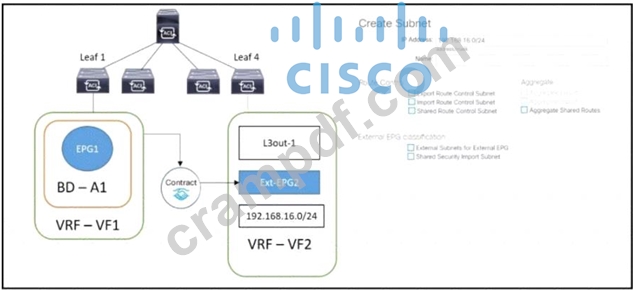
The external subnet and internal EPG1 must communicate with each other, and the L30ut traffic must leak Into the VRF named "VF1". Which configuration set accomplishes these goals?
- A. Export Route Control Subnet Shared Security Import Subnet Aggregate Shared Routes
- B. Export Route Control Subnet Import Route Control Subnet Aggregate Shared Routes
- C. External Subnets for External EPG Import Route Control Subnet Shared Route Control Subnet
- D. External Subnets for External EPG Shared Route Control Subnet Shared Security Import Subnet
Answer: D
NEW QUESTION # 68
Refer to the exhibit.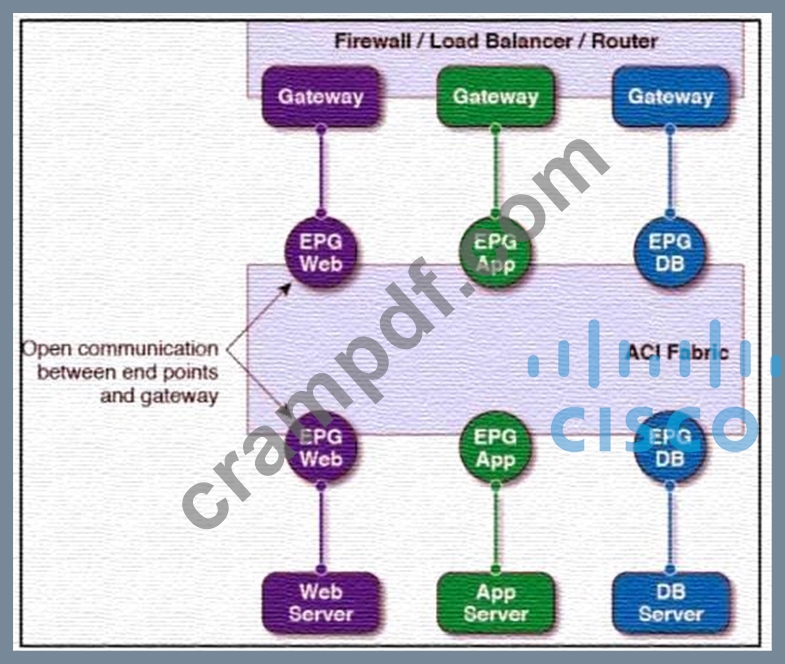
Which type of design approach is shown?
- A. edge-core-edge model
- B. application-centric
- C. traditional VLAN/subnet model
- D. network-centric
Answer: B
Explanation:
The design approach shown in the exhibit is application-centric. This model focuses on the application requirements and defines network policies based on the needs of the application rather than traditional network constructs. It allows for a more dynamic and flexible network configuration that aligns with the application's behavior and interactions.
NEW QUESTION # 69
An engineer deployed a Cisco ACI fabric and noticed that the fabric learns endpoints from subnets that are not configured on a bridge domain. To meet strict security requirements, the engineer must prevent this behavior.
Which action must be taken to prevent this behavior?
- A. Activate Enable Data Plane Endpoint Learning
- B. Configure Static Binding
- C. Implement Pervasive Gateway
- D. Enable Enforce Subnet Check
Answer: D
Explanation:
To ensure the Cisco ACI fabric adheres to strict security protocols and only learns endpoints from configured subnets on a bridge domain, the "Enforce Subnet Check" feature must be enabled. This feature restricts endpoint learning to IP addresses belonging to the subnets defined in the bridge domain associated with the endpoint's VLAN, enhancing security by preventing learning of endpoints from unconfigured subnets. References: Implementing Cisco Application Centric Infrastructure Official Cert Guide
NEW QUESTION # 70
What is the purpose of enabling ARP flooding when VMs are migrated from a pre-existing network to Cisco ACI and their gateways remain configured in the legacy setup?
- A. to allow communication between VMs and silent hosts
- B. to allow VMs to communicate with devices outside of their subnet
- C. to avoid endpoint flapping between the legacy network and the ACI fabric
- D. to prevent VMs from communicating with physical servers within the ACI fabric
Answer: A
NEW QUESTION # 71
What are two characteristics of Cisco ACI and Spanning Tree Protocol interaction? (Choose two.)
- A. MST BPDUs are flooded correctly in Cisco ACI fabric without additional configuration.
- B. STP BPDUs are dropped due to MCP.
- C. BPDU filter and BPDU guard can be configured on Cisco ACI leaf edge ports.
- D. Cisco ACI must be configured as the STP root for all VLANs.
- E. When a TCN BPDU is received in a VLAN, Cisco ACI flushes the endpoints for the associated encapsulation.
Answer: C,D
Explanation:
Section: Traditional network with ACI
Explanation/Reference: https://www.cisco.com/c/en/us/td/docs/switches/datacenter/aci/aci_virtual_edge/configuration/1-x/ b_Virtual_Edge_Config_Guide_1_2_2/b_Virtual_Edge_Config_Guide_1_2_2_chapter_0101.html
NEW QUESTION # 72 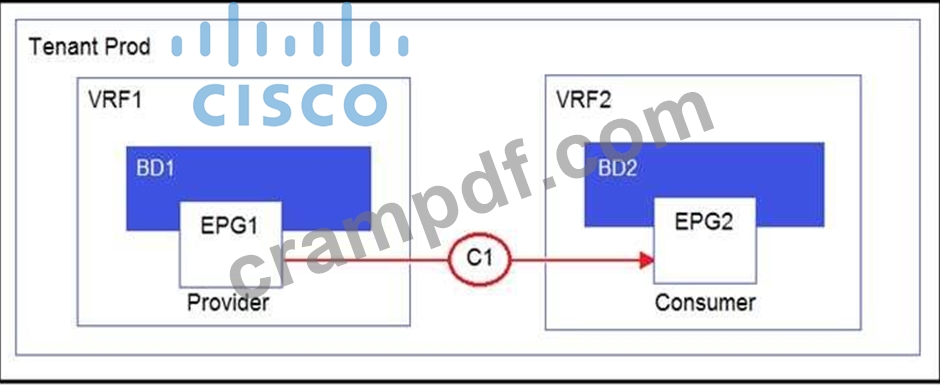
Refer to the exhibit. Which two configurations enable inter-VRF communication? (Choose two.)
- A. Export the contract and import as a contract interface
- B. Change the contract scope to Tenant
- C. Set the subnet scope to Shared Between VRFs
- D. Enable Advertise Externally under the subnet scope
- E. Change the subject scope to VRF
Answer: A,D
Explanation:
Section: Advanced ACI Policies and Integrations
NEW QUESTION # 73
What are two characteristics of network-centric design in Cisco ACI? (Choose two.)
- A. A bridge domain has one subnet and one EPG
- B. There is open communication between EPGs
- C. Applications define the network requirements
- D. EPGs are used formicro segmentation
- E. EPGs are different security zones
Answer: A,B
Explanation:
In a network-centric design within Cisco ACI, there is open communication between EPGs, and a bridge domain typically has one subnet and one EPG. This design is often used for initial migrations and is based on traditional networking concepts.
References := Network Centric to ACI Centric Migration - Cisco
NEW QUESTION # 74
Which action should be taken in Cisco ACI to reassign a unique globally scoped pcTag to an EPG that provides a global contract?
- A. Configure subnets that advertise externally
- B. Configure subnets that are shared between VRFs
- C. Configure subnets that are private to VRF
- D. Configure subnets that are treated as virtual IP
Answer: B
Explanation:
In Cisco ACI, to reassign a unique globally scoped pcTag to an Endpoint Group (EPG) that provides a global contract, one should configure subnets that are shared between VRFs (Virtual Routing and Forwarding instances) (Option C). This action allows subnets associated with an EPG to be shared across different VRFs while maintaining unique identifiers for application endpoint groups within the global scope of the fabric.
References := ( Implementing Cisco Application Centric Infrastructure Official Cert Guide )
NEW QUESTION # 75
Refer to the exhibit.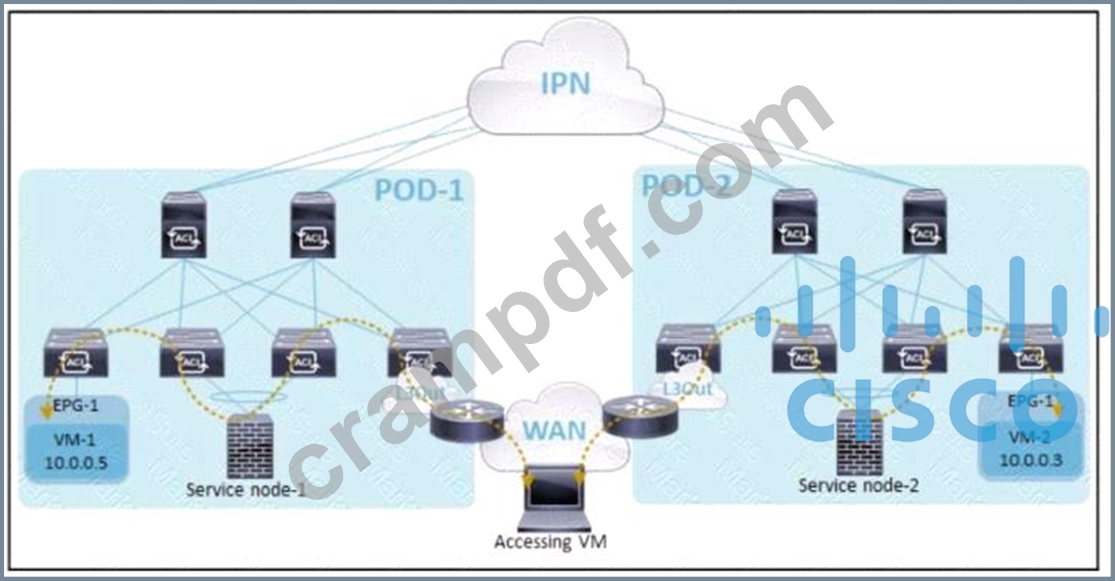
The requirement Is to prefer the local PBR node and redirect the traffic to the remote pod PBR node in the case of catastrophic node failure. Which configuration meets these requirements?
- A. * symmetric PBR
* unidirectional PBR
* resilient hashing - B. * location-based PBR
* host route advertisement
* resilient hashing - C. * location-based PBR
* host route advertisement
* node tracking - D. * symmetric PBR
* location-based PBR
* resilient hashing
Answer: B
NEW QUESTION # 76
A customer plans to deploy a Cisco ACI Multi-Pod deployment. Which two features must be implemented on the IPN switches?
- A. * Enable BIDIR-PIM.
* Configure a maximum multicast range of/23. - B. * Enable BIDIR-PIM.
* Configure a minimum multicast range of/15. - C. * Configure PIM anycast RP.
* Configure a maximum multicast range of /15. - D. * Configure PIM anycast RP.
* Configure a minimum multicast range of 123.
Answer: C
NEW QUESTION # 77
An engineer configures Cisco ACI Multi-Site and must specify the control plane TEP IP for spines. Which statement describes control plane TEP IP in this situation?
- A. The unique IP address is defined on each spine node that belongs to a fabric and is used to establish MP-BGP EVPN and VPNv4 adjacencies with the spine nodes in remote sites.
- B. The unique IP address is defined on each spine node that belongs to a fabric and is used to establish VXLAN adjacencies with the spine nodes in remote sites.
- C. The common anycast address is shared by all the spine nodes in the same site and is used to perform headend replication for BUM traffic.
- D. The common anycast address is shared by all the spine nodes at the same site and is used to source and receive unicast VXLAN data plane traffic.
Answer: A
NEW QUESTION # 78 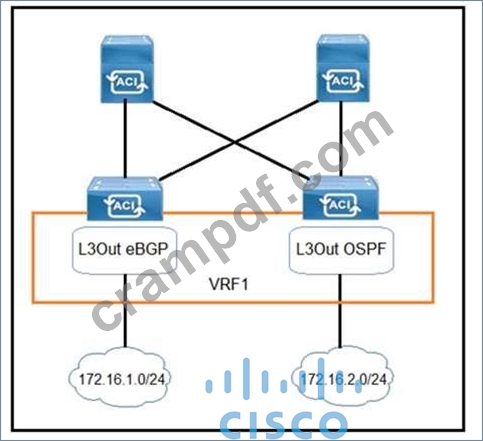
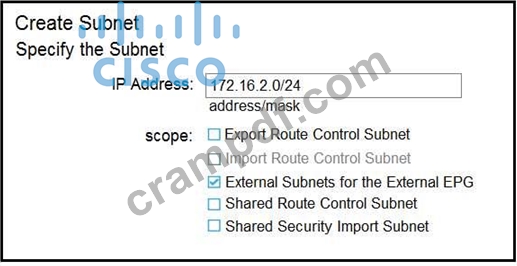
Refer to the exhibit. Which configuration must be implemented on L3Out EBGP to advertise out of the fabric
172.16.2.0/24 network that is learned from L3Out OSPF?
- A.
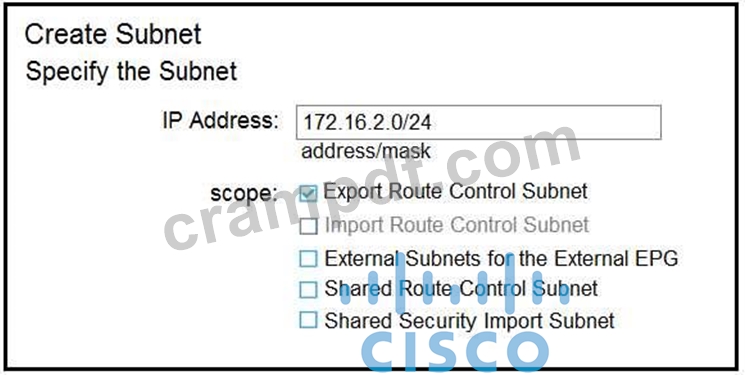
- B.
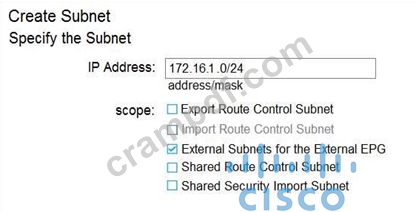
- C.
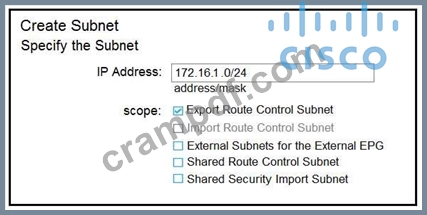
- D.
Answer: A
Explanation:
Section: Advanced ACI Policies and Integrations
NEW QUESTION # 79
What is the purpose of enabling ARP flooding when VMs are migrated from a pre-existing network to Cisco ACI and their gateways remain configured in the legacy setup?
- A. to allow communication between VMs and silent hosts
- B. to allow VMs to communicate with devices outside of their subnet
- C. to avoid endpoint flapping between the legacy network and the ACI fabric
- D. to prevent VMs from communicating with physical servers within the ACI fabric
Answer: A
Explanation:
Enabling ARP flooding is necessary when VMs are migrated from a pre-existing network to Cisco ACI and their gateways remain in the legacy setup. This allows the ACI fabric to learn about silent hosts that do not initiate communication, ensuring that the migrated VMs can communicate with all hosts in the network, including those that are silent.
NEW QUESTION # 80
Refer to the exhibit.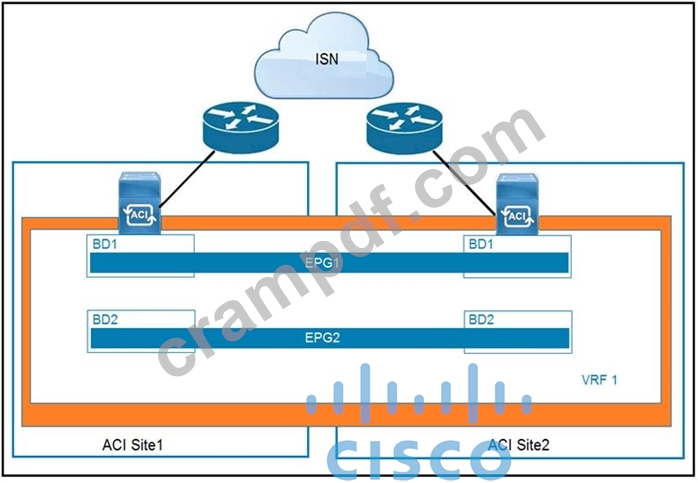
Which feature is available across sites if EPGs are stretched?
- A. active-active high-availability firewall clustering
- B. Layer 3 routing between sites
- C. live virtual machine migration
- D. Layer 2 flooding across sites
Answer: B
NEW QUESTION # 81
......
Pass CCNP Data Center 300-630 Exam With 120 Questions: https://actualtests.crampdf.com/300-630-exam-prep-dumps.html