


325 Exam Questions for 1z0-071 Updated Versions With Test Engine
Pass 1z0-071 Exam with Updated 1z0-071 Exam Dumps PDF 2026
Oracle 1z0-071 (Oracle Database SQL) Certification Exam is an industry-recognized certification that validates the skills of SQL developers, database administrators, and database designers. 1z0-071 exam is designed to test the candidate's knowledge of SQL language, database concepts, and data modeling. The Oracle 1z0-071 certification is considered one of the most prestigious certifications in the IT industry, and it is highly recognized by leading IT organizations worldwide.
Preparing for the Oracle 1z1-071 exam requires a solid understanding of SQL and the Oracle Database. Candidates can prepare for the exam by taking courses, reading study guides, and practicing with sample exam questions. Passing the Oracle 1z1-071 exam is an excellent way to demonstrate your SQL skills and enhance your career opportunities in the field of database administration and development.
NEW QUESTION # 81
The sales table has columns prod_id and quantity_sold of data type number. Which two queries execute successfully?
- A. SELECT prod Id FROH sales NHERE quantity sold > 55000 3RODI BY prod_id HAVING COUNT(*) > 10;
- B. SELECT COUNT(prod_id) FROM sales WHERE quantity_sold > 55000 GROUP BY prod_id;
- C. SELECT COUNT(prod_id) FROM sales GROUP BY prod_id WHERE quantity_sold > 55000;
- D. SELECT prod_id FROM sales WHERE quantity_sold > 55000 AND COUNT(*) > 10 GROUP BY prod_id HAVING COUNT(*) > 10;
- E. SELECT prod_id FROM sales WHERE quantity_sold > 55000 AND
COUNT(*) > 10 GROUP BY COUNT(*) > 10;
Answer: A,B
NEW QUESTION # 82
In the customers table, the CUST_CITY column contains the value 'Paris' for the CUST_FIRST_NAME 'Abigail'.
Evaluate the following query:
What would be the outcome?
- A. Abigail IS
- B. An error message
- C. Abigail Pa
- D. Abigail PA
Answer: C
NEW QUESTION # 83
View the exhibit and examine the structure and data in the INVOICE table.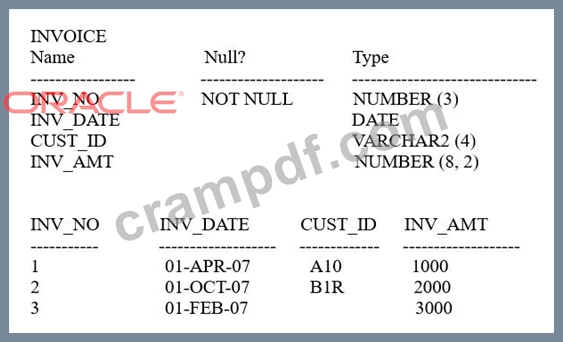
Which two SQL statements would execute successfully? (Choose two.)
- A. SELECT MAX(AVG(SYSDATE -inv_date))FROM invoice;
- B. SELECT MAX(inv_date),MIN(cust_id)FROM invoice;
- C. SELECT AVG( inv_date - SYSDATE), AVG(inv_amt)FROM invoice;
- D. SELECT AVG(inv_date)FROM invoice;
Answer: B,C
NEW QUESTION # 84
Table HR.EMPLOYEEScontains a row where the EMPLOYEE_IDis 109.
User ALICEhas no privileges to access HR.EMPLOYEES.
User ALICEstarts a session.
User HRstarts a session and successfully executes these statements:
GRANT DELETE ON employees TO alice;
UPDATE employees SET salary = 24000 WHERE employee_id = 109;
In her existing session ALICEthen executes:
DELETE FROM hr.employees WHERE employee_id = 109;
What is the result?
- A. The DELETEcommand will wait for HR'Stransaction to end then return an error.
- B. The DELETEcommand will immediately delete the row.
- C. The DELETEcommand will wait for HR'Stransaction to end then delete the row.
- D. The DELETEcommand will immediately return an error.
Answer: B
NEW QUESTION # 85
Examine the structure of the MEMBERStable: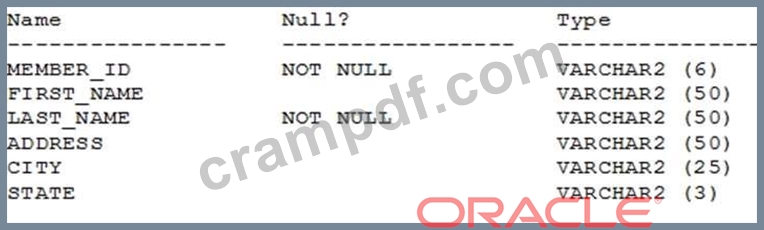
You want to display details of all members who reside in states starting with the letter A followed by exactly one character.
Which SQL statement must you execute?
- A. SELECT * FROM MEMBERS WHERE state LIKE 'A_';
- B. SELECT * FROM MEMBERS WHERE state LIKE 'A_%';
- C. SELECT * FROM MEMBERS WHERE state LIKE 'A%';
- D. SELECT * FROM MEMBERS WHERE state LIKE '%A_';
Answer: A
NEW QUESTION # 86
Examine the description of the PRODUCT_INFORMATION table: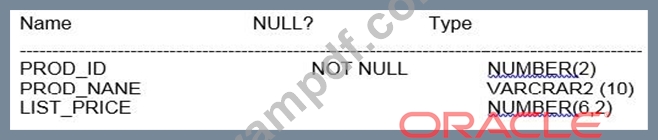
- A. SELECT count(nvl( list_price,0)) FROM product_information WHERE list_price is null;
- B. SELECT COUNT(DISTINCT list_price) FROM product_information WHERE list_price is null.
- C. SELECT (COUNT(list_price) FROM Product_intormation WHERE list_price=NULL;
- D. BELECT COUNT(list_price) FROM product_information where list_price is NULL;
Answer: A
NEW QUESTION # 87
Which three statements are true regarding the data types?
- A. The minimum column width that can be specified for a VARCHAR2data type column is one.
- B. A TIMESTAMPdata type column stores only time values with fractional seconds.
- C. The BLOBdata type column is used to store binary data in an operating system file.
- D. The value for a CHARdata type column is blank-padded to the maximum defined column width.
- E. Only one LONGcolumn can be used per table.
Answer: A,D,E
NEW QUESTION # 88
Examine the structure of the ORDERS table: (Choose the best answer.)
You want to find the total value of all the orders for each year and issue this command:
SQL> SELECT TO_CHAR(order_date,'rr'), SUM(order_total) FROM orders
GROUP BY TO_CHAR(order_date, 'yyyy');
Which statement is true regarding the result?
- A. It executes successfully but gives the correct output.
- B. It returns an error because the TO_CHAR function is not valid.
- C. It executes successfully but does not give the correct output.
- D. It return an error because the datatype conversion in the SELECT list does not match the data type conversion in the GROUP BY clause.
Answer: D
NEW QUESTION # 89
View the Exhibit and examine the structure of the ORDERS table.
The columns ORDER_MODE and ORDER TOTAL have the default values'direct "and respectively.
Which two INSERT statements are valid? (Choose two.)
- A. INSERT INTO orders (order_id, order_date, order mode,customer_id, order_total) VALUES (1, TO_DATE (NULL),'online',101, NULL) ;
- B. INSERT INTO (SELECT order_id, order date, customer_id FROM orders) VALUES (1,
'09-mar-2007"101); - C. INSERT INTO orders VALUES (1, '09-mar-2007', 'online',' ',1000);
- D. INSERT INTO orders (order id, order_date, order mode, order_total)VALUES (1'10-mar-2007','online', 1000)
- E. INSERT INTO orders VALUES('09-mar-2007'DEFAULT,101, DEFALLT);
Answer: A,D
Explanation:
Regarding valid INSERT statements into the ORDERS table:
* B. This is a valid statement because it uses TO_DATE for potentially setting a NULL date and provides defaults implicitly where not specified, adhering to the column constraints and requirements.
* D. This statement is correctly formatted and provides values for non-optional fields, using DEFAULT implicitly for unspecified optional fields.
Incorrect options:
* A: The subquery format and values provided do not match the expected column count and types for direct insert.
* C: Incorrect format due to an improper string for the ORDER_MODE and possibly incomplete values.
* E: Incorrect syntax; DEFAULT should be correctly capitalized, and the value order and type must match the table structure.
NEW QUESTION # 90
Evaluate the following two queries:
SQL> SELECT cust_last_name, cust_city
FROM customers
WHERE cust_credit_limit IN (1000, 2000, 3000);
SQL> SELECT cust_last_name, cust_city
FROM customers
WHERE cust_credit_limit = 1000 or cust_credit_limit = 2000 or
cust_credit_limit = 3000
Which statement is true regarding the above two queries?
- A. Performance would improve in query 2 only if there are null values in the CUST_CREDIT_LIMIT column.
- B. There would be no change in performance.
- C. Performance would improve in query 2.
- D. Performance would degrade in query 2.
Answer: B
Explanation:
Explanation
References:
http://oraclexpert.com/restricting-and-sorting-data/
NEW QUESTION # 91
You want to write a query that prompts for two column names and the WHERE condition each time It is executed in a session but only prompts for the table name the first time it is executed. The variables used in your
query are never undefined in your session . Which query can be used?
- A. SELECT &&col1,&&col2
FROM &table
WHERE &&condition= &&cond; - B. SELECT&&col1, &&col2
FROM &table
WHERE &&condition; - C. SELECT'&co11','&&co12'
FROM &table
WHERE'&&condition' ='&cond'; - D. SELECT &col1, &col2
FROM "&table"
WHERE &condition; - E. SELECT &col1, &col2
FROM &&table
WHERE &condition;
Answer: E
NEW QUESTION # 92
Which two are true about granting privilege on objects?
- A. A table owner must grant the references privilege to allow other users to create FOREIGN KEY constraints using that table.
- B. The WITH GRANT OPTION clause can be used only by DBA users.
- C. An object privilege can be granted to other users only by the owner of object.
- D. An object privilege can be granted to a role only by the owner of that object.
- E. The owner of an object acquires all object privilege on that object by default.
Answer: A,E
Explanation:
A: True, the owner of an object in Oracle automatically has all privileges on that object. This means they can perform any operation on the object, including SELECT, INSERT, UPDATE, DELETE, and so forth.C. True, the REFERENCES privilege must be granted explicitly by the table owner to another user or role to allow the grantee to define foreign key constraints that reference the primary or unique key of the owner's table. This is crucial in scenarios involving relational integrity constraints across tables owned by different users.
References:
* Oracle documentation on object privileges: Oracle Database SQL Language Reference
* Explanation of REFERENCES privilege: Oracle Database Security Guide
NEW QUESTION # 93
View the exhibit and examine the structure of the PROMOTIONS table.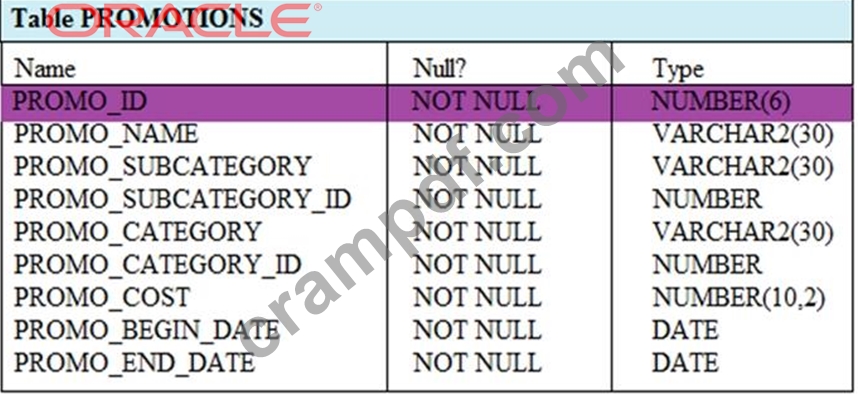
You have to generate a report that displays the promo name and start date for all promos that started after the last promo in the 'INTERNET' category.
Which query would give you the required output?
- A. SELECT promo_name, promo_begin_date FROM promotions
WHERE promo_begin_date> ANY (SELECT promo_begin_date
FROM promotions
WHERE promo_category= 'INTERNET'); - B. SELECT promo_name, promo_begin_date FROM promotions
WHERE promo_begin_date> ALL (SELECT MAX (promo_begin_date)
FROM promotions) AND
promo_category= 'INTERNET'; - C. SELECT promo_name, promo_begin_date FROM promotions
WHERE promo_begin_date > ALL (SELECT promo_begin_date
FROM promotions
WHERE promo_category = 'INTERNET'); - D. SELECT promo_name, promo_begin_date FROM promotions
WHERE promo_begin_date IN (SELECT promo_begin_date
FROM promotions
WHERE promo_category= 'INTERNET');
Answer: C
NEW QUESTION # 94
View the Exhibit and examine the description of the tables.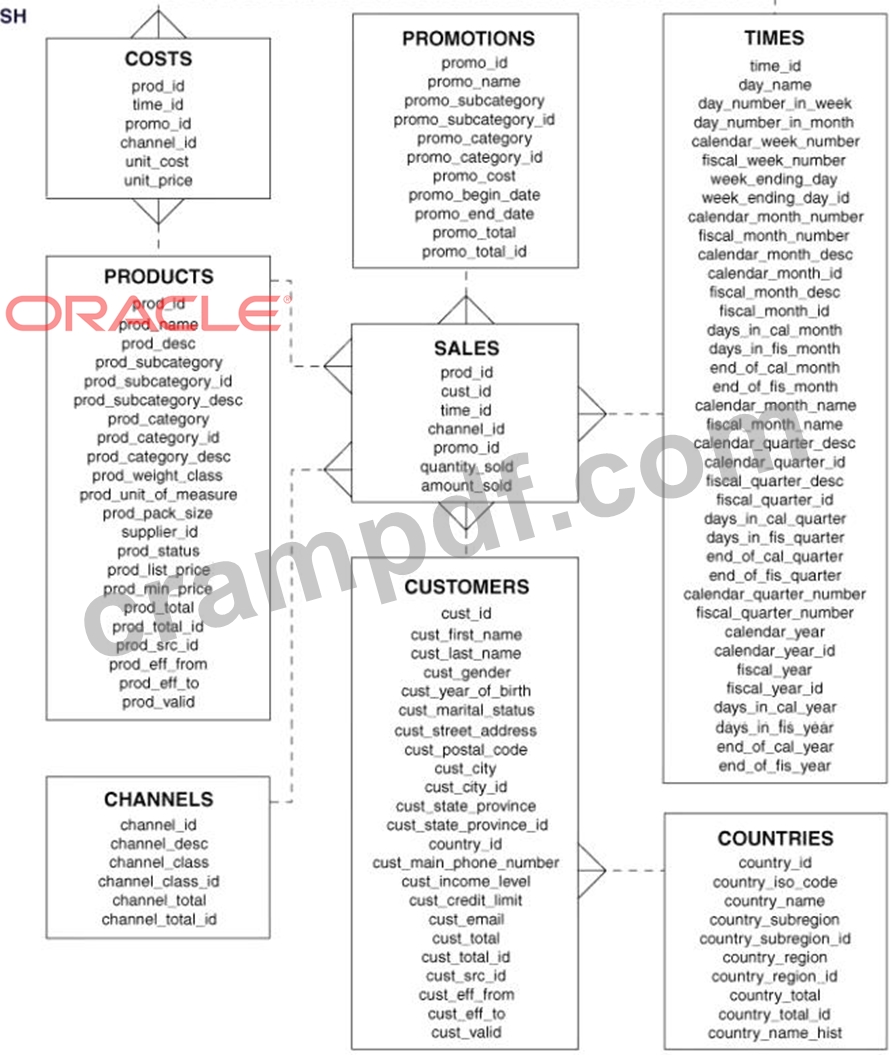
You execute this SQL statement: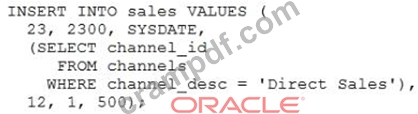
Which three statements are true?
- A. The SALES table has five foreign keys.
- B. The statement will execute successfully and a new row will be inserted into the SALES table.
- C. The statement will fail because a subquery may not be contained in a VALUES clause.
- D. A product can have a different unit price at different times.
- E. The statement will fail if a row already exists in the SALES table for product 23.
- F. A customer can exist in many countries.
Answer: A,B,F
NEW QUESTION # 95
View the exhibit and examine the description of the EMPLOYEES table. (Choose two.)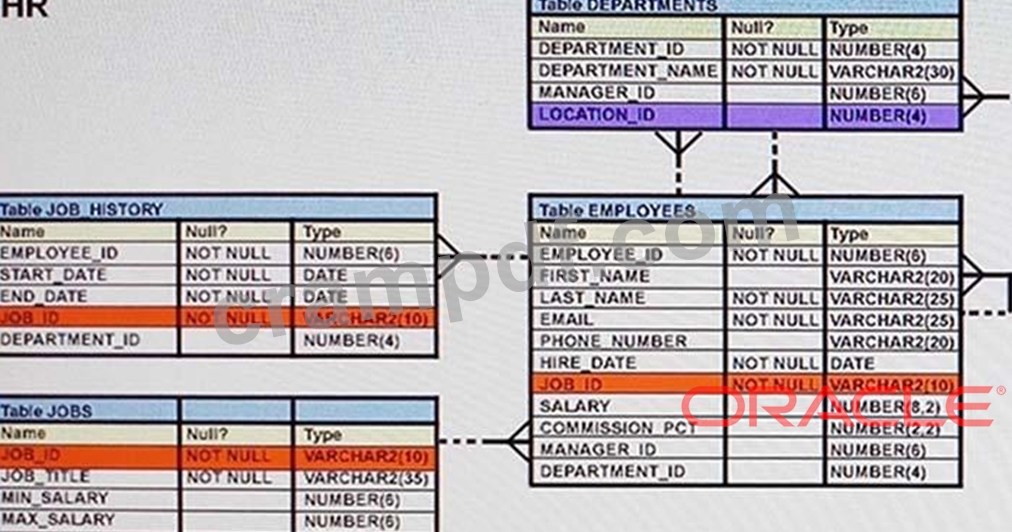
You executed this SQL statement:
SELECT first_name, department_id, salary
FROM employees
ORDER BY department_id, first_name, salary desc;
Which two statements are true regarding the result? (Choose two.)
- A. The values in all columns would be returned in descending order.
- B. The values in the FIRST_NAME column would be returned in descending order for all employees having the same value in the DEPARTMENT_ID column.
- C. The values in the SALARY column would be returned in descending order for all employees having the same value in the DEPARTMENT_ID column.
- D. The values in the SALARY column would be returned in descending order for all employees having the same value in the DEPARTMENT_ID and FIRST_NAME column.
- E. The values in the FIRST_NAME column would be returned in ascending order for all employees having the same value in the DEPARTMENT_ID column.
Answer: D,E
NEW QUESTION # 96
......
Oracle 1z0-071 exam, also known as the Oracle Database SQL exam, is a certification exam designed to evaluate the skills and knowledge of individuals in SQL database management. 1z0-071 exam is intended for database administrators, developers, and IT professionals who use SQL as a part of their daily work. 1z0-071 exam is divided into multiple sections that cover different aspects of SQL, such as data retrieval, manipulation, and management. 1z0-071 exam validates the ability to use SQL to manage data in an Oracle database environment, as well as the ability to create and maintain database objects such as tables, views, and indexes.
1z0-071 Exam Dumps - Free Demo & 365 Day Updates: https://actualtests.crampdf.com/1z0-071-exam-prep-dumps.html