


100% PASS RATE Google Cloud Certified Professional-Data-Engineer Certified Exam DUMP with 392 Questions
Updates For the Latest Professional-Data-Engineer Free Exam Study Guide!
Google Professional-Data-Engineer certification exam is a highly sought-after certification in the field of data engineering. Google Certified Professional Data Engineer Exam certification is designed for professionals who possess the necessary skills and knowledge to design, build, and maintain data processing systems. Professional-Data-Engineer exam is intended to test the candidate's ability to work with large volumes of data, design scalable data processing systems, and implement solutions that are highly available, reliable, and secure.
NEW QUESTION # 154
You are collecting loT sensor data from millions of devices across the world and storing the data in BigQuery.
Your access pattern is based on recent data tittered by location_id and device_version with the following query: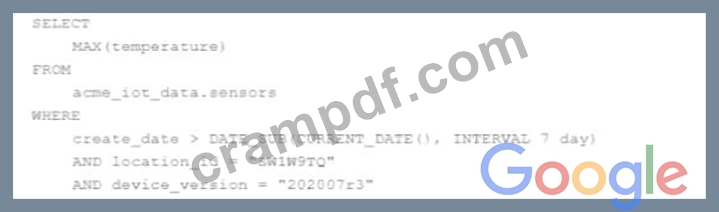
You want to optimize your queries for cost and performance. How should you structure your data?
- A. Partition table data by create_date, location_id and device_version
- B. Cluster table data by create_date, partition by location and device_version
- C. Partition table data by create_date cluster table data by tocation_id and device_version
- D. Cluster table data by create_date location_id and device_version
Answer: D
NEW QUESTION # 155
You have historical data covering the last three years in BigQuery and a data pipeline that delivers new data to BigQuery daily. You have noticed that when the Data Science team runs a query filtered on a date column and limited to 3090 days of data, the query scans the entire table. You also noticed that your bill is increasing more quickly than you expected. You want to resolve the issue as cost-effectively as possible while maintaining the ability to conduct SQL queries. What should you do?
- A. Recommend that the Data Science team export the table to a CSV file on Cloud Storage and use Cloud Datalab to explore the data by reading the files directly.
- B. Write an Apache Beam pipeline that creates a BigQuery table per day. Recommend that the Data Science team use wildcards on the table name suffixes to select the data they need.
- C. Re-create the tables using DDL. Partition the tables by a column containing a TIMESTAMP or DATE Type.
- D. Modify your pipeline to maintain the last 3090 days of data in one table and the longer history in a different table to minimize full table scans over the entire history.
Answer: C
NEW QUESTION # 156
You are managing a Cloud Dataproc cluster. You need to make a job run faster while minimizing costs, without losing work in progress on your clusters. What should you do?
- A. Increase the cluster size with preemptible worker nodes, and use Cloud Stackdriver to trigger a script to preserve work.
- B. Increase the cluster size with preemptible worker nodes, and configure them to use graceful decommissioning.
- C. Increase the cluster size with preemptible worker nodes, and configure them to forcefully decommission.
- D. Increase the cluster size with more non-preemptible workers.
Answer: B
Explanation:
Explanation/Reference:
Reference https://cloud.google.com/dataproc/docs/concepts/configuring-clusters/flex
NEW QUESTION # 157
MJTelco's Google Cloud Dataflow pipeline is now ready to start receiving data from the 50,000 installations. You want to allow Cloud Dataflow to scale its compute power up as required. Which Cloud Dataflow pipeline configuration setting should you update?
- A. The zone
- B. The disk size per worker
- C. The maximum number of workers
- D. The number of workers
Answer: A
NEW QUESTION # 158
If you're running a performance test that depends upon Cloud Bigtable, all the choices except one below are recommended steps. Which is NOT a recommended step to follow?
- A. Do not use a production instance.
- B. Run your test for at least 10 minutes.
- C. Before you test, run a heavy pre-test for several minutes.
- D. Use at least 300 GB of data.
Answer: A
Explanation:
Explanation
If you're running a performance test that depends upon Cloud Bigtable, be sure to follow these steps as you plan and execute your test:
Use a production instance. A development instance will not give you an accurate sense of how a production instance performs under load.
Use at least 300 GB of data. Cloud Bigtable performs best with 1 TB or more of data. However, 300 GB of data is enough to provide reasonable results in a performance test on a 3-node cluster. On larger clusters, use
100 GB of data per node.
Before you test, run a heavy pre-test for several minutes. This step gives Cloud Bigtable a chance to balance data across your nodes based on the access patterns it observes.
Run your test for at least 10 minutes. This step lets Cloud Bigtable further optimize your data, and it helps ensure that you will test reads from disk as well as cached reads from memory.
Reference: https://cloud.google.com/bigtable/docs/performance
NEW QUESTION # 159
You are testing a Dataflow pipeline to ingest and transform text files. The files are compressed gzip, errors are written to a dead-letter queue, and you are using Sidelnputs to join data You noticed that the pipeline is taking longer to complete than expected, what should you do to expedite the Dataflow job?
- A. Reduce the batch size
- B. Use CoGroupByKey instead of the Sidelnput
- C. Switch to compressed Avro files
- D. Retry records that throw an error
Answer: A
NEW QUESTION # 160
You work for a large real estate firm and are preparing 6 TB of home sales data lo be used for machine learning You will use SOL to transform the data and use BigQuery ML lo create a machine learning model. You plan to use the model for predictions against a raw dataset that has not been transformed. How should you set up your workflow in order to prevent skew at prediction time?
- A. Use a BigOuery to define your preprocessing logic. When creating your model, use the view as your model training data. At prediction lime, use BigQuery's ML EVALUATE clause without specifying any transformations on the raw input data.
- B. When creating your model, use BigQuery's TRANSFORM clause to define preprocessing steps Before requesting predictions, use a saved query to transform your raw input data, and then use ML. EVALUATE
- C. When creating your model, use BigQuerys TRANSFORM clause to define preprocessing stops. At prediction time, use BigQuery"s ML. EVALUATE clause without specifying any transformations on the raw input data.
- D. Preprocess all data using Dataflow. At prediction time, use BigOuery"s ML. EVALUATE clause without specifying any further transformations on the input data.
Answer: C
Explanation:
https://cloud.google.com/bigquery-ml/docs/bigqueryml-transform Using the TRANSFORM clause, you can specify all preprocessing during model creation. The preprocessing is automatically applied during the prediction and evaluation phases of machine learning
NEW QUESTION # 161
What Dataflow concept determines when a Window's contents should be output based on certain criteria being met?
- A. OutputCriteria
- B. Triggers
- C. Sessions
- D. Windows
Answer: B
Explanation:
Triggers control when the elements for a specific key and window are output. As elements arrive, they are put into one or more windows by a Window transform and its associated WindowFn, and then passed to the associated Trigger to determine if the Windows contents should be output.
Reference: https://cloud.google.com/dataflow/java-sdk/JavaDoc/com/google/cloud/dataflow/sdk/transforms
/windowing/Trigger
NEW QUESTION # 162
Case Study 2 - MJTelco
Company Overview
MJTelco is a startup that plans to build networks in rapidly growing, underserved markets around the world.
The company has patents for innovative optical communications hardware. Based on these patents, they can create many reliable, high-speed backbone links with inexpensive hardware.
Company Background
Founded by experienced telecom executives, MJTelco uses technologies originally developed to overcome communications challenges in space. Fundamental to their operation, they need to create a distributed data infrastructure that drives real-time analysis and incorporates machine learning to continuously optimize their topologies. Because their hardware is inexpensive, they plan to overdeploy the network allowing them to account for the impact of dynamic regional politics on location availability and cost.
Their management and operations teams are situated all around the globe creating many-to-many relationship between data consumers and provides in their system. After careful consideration, they decided public cloud is the perfect environment to support their needs.
Solution Concept
MJTelco is running a successful proof-of-concept (PoC) project in its labs. They have two primary needs:
* Scale and harden their PoC to support significantly more data flows generated when they ramp to more than 50,000 installations.
* Refine their machine-learning cycles to verify and improve the dynamic models they use to control topology definition.
MJTelco will also use three separate operating environments - development/test, staging, and production - to meet the needs of running experiments, deploying new features, and serving production customers.
Business Requirements
* Scale up their production environment with minimal cost, instantiating resources when and where needed in an unpredictable, distributed telecom user community.
* Ensure security of their proprietary data to protect their leading-edge machine learning and analysis.
* Provide reliable and timely access to data for analysis from distributed research workers
* Maintain isolated environments that support rapid iteration of their machine-learning models without affecting their customers.
Technical Requirements
* Ensure secure and efficient transport and storage of telemetry data
* Rapidly scale instances to support between 10,000 and 100,000 data providers with multiple flows each.
* Allow analysis and presentation against data tables tracking up to 2 years of data storing approximately
100m records/day
* Support rapid iteration of monitoring infrastructure focused on awareness of data pipeline problems both in telemetry flows and in production learning cycles.
CEO Statement
Our business model relies on our patents, analytics and dynamic machine learning. Our inexpensive hardware is organized to be highly reliable, which gives us cost advantages. We need to quickly stabilize our large distributed data pipelines to meet our reliability and capacity commitments.
CTO Statement
Our public cloud services must operate as advertised. We need resources that scale and keep our data secure. We also need environments in which our data scientists can carefully study and quickly adapt our models. Because we rely on automation to process our data, we also need our development and test environments to work as we iterate.
CFO Statement
The project is too large for us to maintain the hardware and software required for the data and analysis.
Also, we cannot afford to staff an operations team to monitor so many data feeds, so we will rely on automation and infrastructure. Google Cloud's machine learning will allow our quantitative researchers to work on our high-value problems instead of problems with our data pipelines.
You need to compose visualizations for operations teams with the following requirements:
* The report must include telemetry data from all 50,000 installations for the most resent 6 weeks (sampling once every minute).
* The report must not be more than 3 hours delayed from live data.
* The actionable report should only show suboptimal links.
* Most suboptimal links should be sorted to the top.
* Suboptimal links can be grouped and filtered by regional geography.
* User response time to load the report must be <5 seconds.
Which approach meets the requirements?
- A. Load the data into Google BigQuery tables, write a Google Data Studio 360 report that connects to your data, calculates a metric, and then uses a filter expression to show only suboptimal rows in a table.
- B. Load the data into Google Cloud Datastore tables, write a Google App Engine Application that queries all rows, applies a function to derive the metric, and then renders results in a table using the Google charts and visualization API.
- C. Load the data into Google Sheets, use formulas to calculate a metric, and use filters/sorting to show only suboptimal links in a table.
- D. Load the data into Google BigQuery tables, write Google Apps Script that queries the data, calculates the metric, and shows only suboptimal rows in a table in Google Sheets.
Answer: A
NEW QUESTION # 163
You are developing an application on Google Cloud that will automatically generate subject labels for users' blog posts. You are under competitive pressure to add this feature quickly, and you have no additional developer resources. No one on your team has experience with machine learning. What should you do?
- A. Call the Cloud Natural Language API from your application. Process the generated Sentiment Analysis as labels.
- B. Build and train a text classification model using TensorFlow. Deploy the model using Cloud Machine Learning Engine. Call the model from your application and process the results as labels.
- C. Call the Cloud Natural Language API from your application. Process the generated Entity Analysis as labels.
- D. Build and train a text classification model using TensorFlow. Deploy the model using a Kubernetes Engine cluster. Call the model from your application and process the results as labels.
Answer: C
NEW QUESTION # 164
You use BigQuery as your centralized analytics platform. New data is loaded every day, and an ETL pipeline modifies the original data and prepares it for the final users. This ETL pipeline is regularly modified and can generate errors, but sometimes the errors are detected only after 2 weeks. You need to provide a method to recover from these errors, and your backups should be optimized for storage costs. How should you organize your data in BigQuery and store your backups?
- A. Organize your data in separate tables for each month, and use snapshot decorators to restore the table to a time prior to the corruption.
- B. Organize your data in separate tables for each month, and export, compress, and store the data in Cloud Storage.
- C. Organize your data in a single table, export, and compress and store the BigQuery data in Cloud Storage.
- D. Organize your data in separate tables for each month, and duplicate your data on a separate dataset in BigQuery.
Answer: A
Explanation:
Explanation
NEW QUESTION # 165
Your company is in a highly regulated industry. One of your requirements is to ensure individual users have access only to the minimum amount of information required to do their jobs. You want to enforce this requirement with Google BigQuery. Which three approaches can you take? (Choose three.)
- A. Ensure that the data is encrypted at all times.
- B. Restrict access to tables by role.
- C. Restrict BigQuery API access to approved users.
- D. Disable writes to certain tables.
- E. Use Google Stackdriver Audit Logging to determine policy violations.
- F. Segregate data across multiple tables or databases.
Answer: B,C,E
Explanation:
Explanation/Reference:
NEW QUESTION # 166
Cloud Dataproc charges you only for what you really use with _____ billing.
- A. minute-by-minute
- B. month-by-month
- C. week-by-week
- D. hour-by-hour
Answer: A
Explanation:
One of the advantages of Cloud Dataproc is its low cost. Dataproc charges for what you really use with minute-by-minute billing and a low, ten-minute-minimum billing period.
Reference: https://cloud.google.com/dataproc/docs/concepts/overview
NEW QUESTION # 167
You architect a system to analyze seismic data. Your extract, transform, and load (ETL) process runs as a series of MapReduce jobs on an Apache Hadoop cluster. The ETL process takes days to process a data set because some steps are computationally expensive. Then you discover that a sensor calibration step has been omitted. How should you change your ETL process to carry out sensor calibration systematically in the future?
- A. Add sensor calibration data to the output of the ETL process, and document that all users need to apply sensor calibration themselves.
- B. Modify the transformMapReduce jobs to apply sensor calibration before they do anything else.
- C. Develop an algorithm through simulation to predict variance of data output from the last MapReduce job based on calibration factors, and apply the correction to all data.
- D. Introduce a new MapReduce job to apply sensor calibration to raw data, and ensure all other MapReduce jobs are chained after this.
Answer: B
NEW QUESTION # 168
You want to use a database of information about tissue samples to classify future tissue samples as either normal or mutated. You are evaluating an unsupervised anomaly detection method for classifying the tissue samples. Which two characteristic support this method? (Choose two.)
- A. You expect future mutations to have similar features to the mutated samples in the database.
- B. There are roughly equal occurrences of both normal and mutated samples in the database.
- C. You already have labels for which samples are mutated and which are normal in the database.
- D. There are very few occurrences of mutations relative to normal samples.
- E. You expect future mutations to have different features from the mutated samples in the database.
Answer: B,E
Explanation:
Explanation/Reference:
NEW QUESTION # 169
You want to create a machine learning model using BigQuery ML and create an endpoint foe hosting the model using Vertex Al. This will enable the processing of continuous streaming data in near-real time from multiple vendors. The data may contain invalid values. What should you do?
- A. Create a Pub'Sub topic and send all vendor data to it Connect a Cloud Function to the topic to process the data and store it in BigQuery.
- B. Use BigQuery streaming inserts to land the data from multiple vendors whore your BigQuery dataset ML model is deployed.
- C. Create a new BigOuery dataset and use streaming inserts to land the data from multiple vendors.
Configure your BigQuery ML model to use the "ingestion' dataset as the training data. - D. Create a Pub/Sub topic and send all vendor data to it Use Dataflow to process and sanitize the Pub/Sub data and stream it to BigQuery.
Answer: D
Explanation:
Dataflow provides a scalable and flexible way to process and clean the incoming data in real-time before loading it into BigQuery.
NEW QUESTION # 170
You're training a model to predict housing prices based on an available dataset with real estate properties.
Your plan is to train a fully connected neural net, and you've discovered that the dataset contains latitude and longitude of the property. Real estate professionals have told you that the location of the property is highly influential on price, so you'd like to engineer a feature that incorporates this physical dependency.
What should you do?
- A. Create a numeric column from a feature cross of latitude and longitude.
- B. Provide latitude and longitude as input vectors to your neural net.
- C. Create a feature cross of latitude and longitude, bucketize at the minute level and use L1 regularization during optimization.
- D. Create a feature cross of latitude and longitude, bucketize it at the minute level and use L2 regularization during optimization.
Answer: A
Explanation:
Explanation/Reference:
Reference https://cloud.google.com/bigquery/docs/gis-data
NEW QUESTION # 171
A shipping company has live package-tracking data that is sent to an Apache Kafka stream in real time. This is then loaded into BigQuery. Analysts in your company want to query the tracking data in BigQuery to analyze geospatial trends in the lifecycle of a package. The table was originally created with ingest-date partitioning.
Over time, the query processing time has increased. You need to implement a change that would improve query performance in BigQuery. What should you do?
- A. Implement clustering in BigQuery on the package-tracking ID column.
- B. Implement clustering in BigQuery on the ingest date column.
- C. Tier older data onto Cloud Storage files, and leverage extended tables.
- D. Re-create the table using data partitioning on the package delivery date.
Answer: B
NEW QUESTION # 172
You are a head of BI at a large enterprise company with multiple business units that each have different priorities and budgets. You use on-demand pricing for BigQuery with a quota of 2K concurrent on-demand slots per project. Users at your organization sometimes don't get slots to execute their query and you need to correct this. You'd like to avoid introducing new projects to your account.
What should you do?
- A. Create an additional project to overcome the 2K on-demand per-project quota.
- B. Increase the amount of concurrent slots per project at the Quotas page at the Cloud Console.
- C. Convert your batch BQ queries into interactive BQ queries.
- D. Switch to flat-rate pricing and establish a hierarchical priority model for your projects.
Answer: D
Explanation:
Explanation
Reference https://cloud.google.com/blog/products/gcp/busting-12-myths-about-bigquery
NEW QUESTION # 173
Your company is streaming real-time sensor data from their factory floor into Bigtable and they have noticed extremely poor performance. How should the row key be redesigned to improve Bigtable performance on queries that populate real-time dashboards?
- A. Use a row key of the form <sensorid>.
- B. Use a row key of the form <timestamp>#<sensorid>.
- C. Use a row key of the form <timestamp>.
- D. Use a row key of the form >#<sensorid>#<timestamp>.
Answer: C
NEW QUESTION # 174
MJTelco Case Study
Company Overview
MJTelco is a startup that plans to build networks in rapidly growing, underserved markets around the world. The company has patents for innovative optical communications hardware. Based on these patents, they can create many reliable, high-speed backbone links with inexpensive hardware.
Company Background
Founded by experienced telecom executives, MJTelco uses technologies originally developed to overcome communications challenges in space. Fundamental to their operation, they need to create a distributed data infrastructure that drives real-time analysis and incorporates machine learning to continuously optimize their topologies. Because their hardware is inexpensive, they plan to overdeploy the network allowing them to account for the impact of dynamic regional politics on location availability and cost.
Their management and operations teams are situated all around the globe creating many-to-many relationship between data consumers and provides in their system. After careful consideration, they decided public cloud is the perfect environment to support their needs.
Solution Concept
MJTelco is running a successful proof-of-concept (PoC) project in its labs. They have two primary needs:
* Scale and harden their PoC to support significantly more data flows generated when they ramp to more than
50,000 installations.
* Refine their machine-learning cycles to verify and improve the dynamic models they use to control topology definition.
MJTelco will also use three separate operating environments - development/test, staging, and production - to meet the needs of running experiments, deploying new features, and serving production customers.
Business Requirements
* Scale up their production environment with minimal cost, instantiating resources when and where needed in an unpredictable, distributed telecom user community.
* Ensure security of their proprietary data to protect their leading-edge machine learning and analysis.
* Provide reliable and timely access to data for analysis from distributed research workers
* Maintain isolated environments that support rapid iteration of their machine-learning models without affecting their customers.
Technical Requirements
Ensure secure and efficient transport and storage of telemetry data
Rapidly scale instances to support between 10,000 and 100,000 data providers with multiple flows each.
Allow analysis and presentation against data tables tracking up to 2 years of data storing approximately 100m records/day Support rapid iteration of monitoring infrastructure focused on awareness of data pipeline problems both in telemetry flows and in production learning cycles.
CEO Statement
Our business model relies on our patents, analytics and dynamic machine learning. Our inexpensive hardware is organized to be highly reliable, which gives us cost advantages. We need to quickly stabilize our large distributed data pipelines to meet our reliability and capacity commitments.
CTO Statement
Our public cloud services must operate as advertised. We need resources that scale and keep our data secure.
We also need environments in which our data scientists can carefully study and quickly adapt our models.
Because we rely on automation to process our data, we also need our development and test environments to work as we iterate.
CFO Statement
The project is too large for us to maintain the hardware and software required for the data and analysis. Also, we cannot afford to staff an operations team to monitor so many data feeds, so we will rely on automation and infrastructure. Google Cloud's machine learning will allow our quantitative researchers to work on our high- value problems instead of problems with our data pipelines.
You need to compose visualization for operations teams with the following requirements:
* Telemetry must include data from all 50,000 installations for the most recent 6 weeks (sampling once every minute)
* The report must not be more than 3 hours delayed from live data.
* The actionable report should only show suboptimal links.
* Most suboptimal links should be sorted to the top.
* Suboptimal links can be grouped and filtered by regional geography.
* User response time to load the report must be <5 seconds.
You create a data source to store the last 6 weeks of data, and create visualizations that allow viewers to see multiple date ranges, distinct geographic regions, and unique installation types. You always show the latest data without any changes to your visualizations. You want to avoid creating and updating new visualizations each month. What should you do?
- A. Look through the current data and compose a small set of generalized charts and tables bound to criteria filters that allow value selection.
- B. Load the data into relational database tables, write a Google App Engine application that queries all rows, summarizes the data across each criteria, and then renders results using the Google Charts and visualization API.
- C. Look through the current data and compose a series of charts and tables, one for each possible combination of criteria.
- D. Export the data to a spreadsheet, compose a series of charts and tables, one for each possible combination of criteria, and spread them across multiple tabs.
Answer: A
NEW QUESTION # 175
......
Best Professional-Data-Engineer Exam Preparation Material with New Dumps Questions https://actualtests.crampdf.com/Professional-Data-Engineer-exam-prep-dumps.html